
Unclosed list
Although this is not a specialized service, every blog post and every object added to the map is preceded by a more or less detailed source query. And with the planned expansion to include a section dedicated to the city’s occupation period - covering, among others, German-speaking tourists from the West and from Southern Europe - this requires particular diligence.
Delving into sources quickly leads to less obvious areas. Niche materials appear, sometimes more challenging or demanding - but often the most interesting threads are hidden precisely there.
While working on sites associated with the period when Hans Frank resided at Wawel - including places connected with KL Plaszow and the activities of his administration, as well as with the figure of Oskar Schindler - we came across a fairly recent article. We felt it was worth mentioning on the blog.
We are talking about Scott Feinberg’s article “Schindler’s List: An Oral History of a Masterpiece”, published on February 21, 2024, in The Hollywood Reporter.
We approached the reading without prejudice or assumptions, although both the provenance of the publication and the author, as well as the topic itself, could suggest that right after the next paragraph lurks the risk of a brutal cognitive transformation.
Unfortunately, even in the quote preceding the introduction and in the first paragraph, the author and the director themselves present a narrative far from an objective portrayal of the surrounding reality.
These days, tragically, antisemitism is all over the headlines - Scott Feinberg
Of course, we would have liked to provide the entire text in Polish, but due to copyright law, we can only make use of quotation rights and extract the most interesting fragments for you, which we will intersperse with our expressions of surprise and disappointment.
Due to time constraints and the general profile of the service, we will also omit reflections on the film’s titular character. Attempting to assess Oskar Schindler’s actual motivations, his role in creating the famous list, and the role of so-called Nazis is not easy and - for quite obvious reasons - would largely have to rely on subjective interpretations and assumptions.
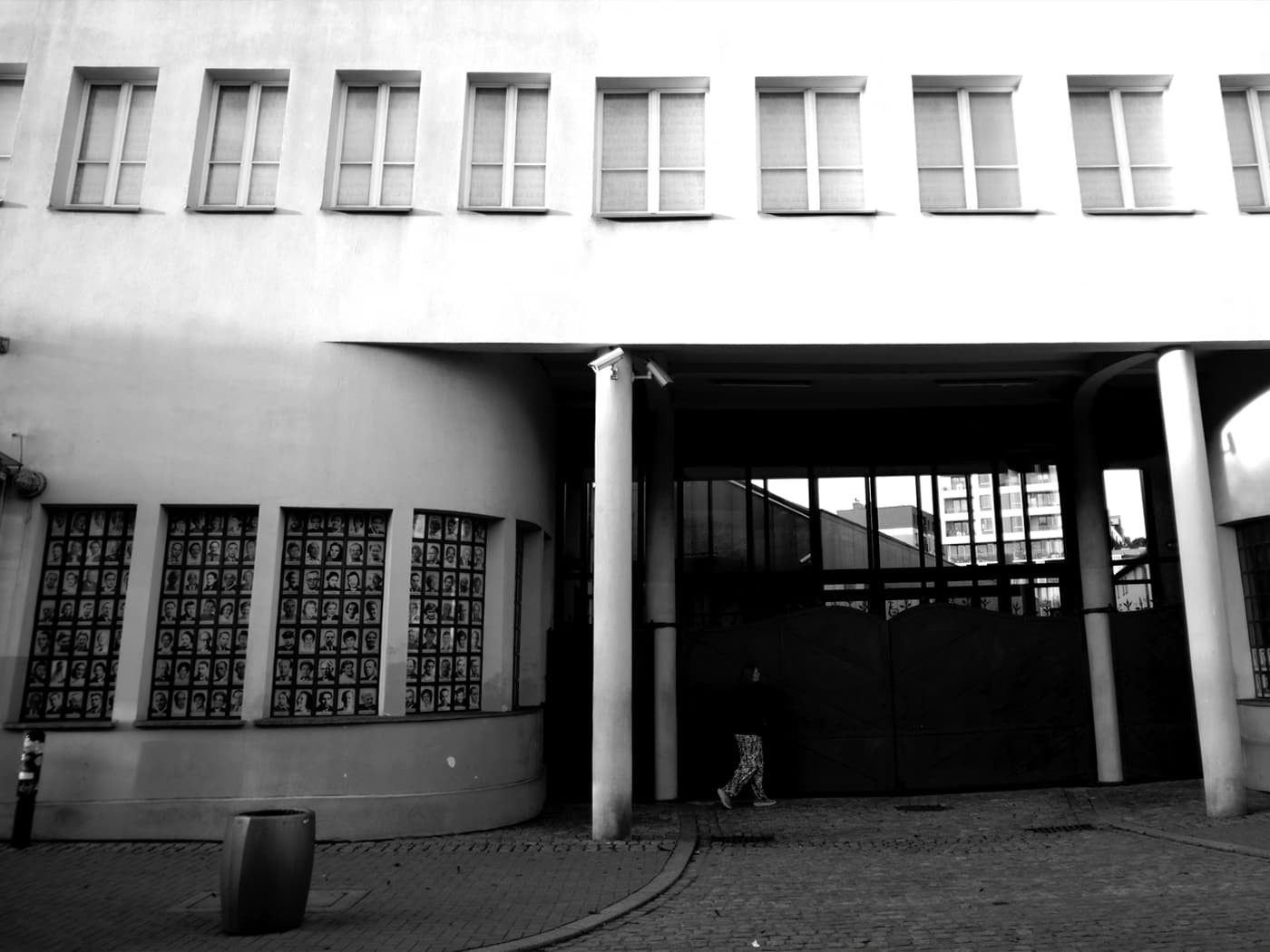
There has never been a more appropriate time to delve into this story. Antisemitism always lurks in a very shallow water table. It’s just under the ground. And every once in a while, it seeps up through the surface, into all of our lives and the news cycle, where we are publicly aware of what people are saying against Jews. - Steven Spielberg
One-sided representations of the world from the perspective of a selected social group, state, or individual are nothing new. Especially today, when information warfare and historical politics permeate our daily lives.
Although expecting artists or people connected with broad creative work to present a fuller view of human existence is sometimes naive, the narrow perspective presented by the director and leading actors in the interview at times becomes downright distasteful.
I collected public school textbooks from California, New York and Chicago, and could not find any references to the Holocaust in the textbooks that were being taught. They mentioned that innocent people were killed by the Nazis. They never said they were Jews. It was alarming what was beginning to happen [overseas, as well]. The whole thing in Bosnia and Herzegovina and Sarajevo, and the term “ethnic cleansing,” that was a motivator for me in a big way - Steven Spielberg
Only occasionally, in the gaps between quotes full of absurdity, can one extract opinions that contain at least a hint of reason. However, even in the case of the World Jewish Congress - which has often issued statements contrary to the expectations of its own diaspora - it is worth pausing for a moment and asking a justified question about the right of an external federation to grant permissions within a sovereign state, which Poland should be.
The World Jewish Congress wouldn’t let us shoot inside Auschwitz because we were a dramatic narrative, and they had a policy that only documentaries could shoot at Auschwitz. (…) - Steven Spielberg
The deeper into this thicket of words one goes, the less room there is for reason. And the image of the director - celebrated worldwide and awarded for Schindler’s List - loses its luster with each passing sentence.
Keneally wrote about that in the book. I thought it meant much more than just an observation by Oskar. For me, it was like waving a red flag at a world that, because of their own antisemitism, refused to pay much attention to the Holocaust (…) - Steven Spielberg
Unfortunately, even in the case of such a well-known figure, the “besieged fortress” syndrome - carefully instilled in the minds of visitors to Poland who are descendants of former fellow citizens - spills out of the cited quotes.
“We rented a house that before the fall of the wall had been KGB headquarters. It was a very secure bunker with seven rooms, which we converted into bedrooms. It was surrounded by a big fence on a one-and-a-half-acre lot, always covered in snow. There were six of my seven children, sometimes all seven.” - Steven Spielberg
And it doesn’t take long to encounter statements untainted by a real assessment of the surrounding reality.
Some on the film encountered antisemitism in Poland, even a half century after the war - Steven Spielberg
In the opinion of the esteemed Hollywood actor Ben Kingsley - whose original surname the author deliberately mentions - one sees not only a flawed and excessively oversensitive perception of reality, but also an element of narrative creation.
We learn that the antisemitism supposedly so widely encountered by the cast, according to him, was described as a “sinister murmur.”
I can describe it as a low, sinister hum, like a piece of music, running through all our days, this base note of hatred - Ben Kingsley (Itzhak Stern)
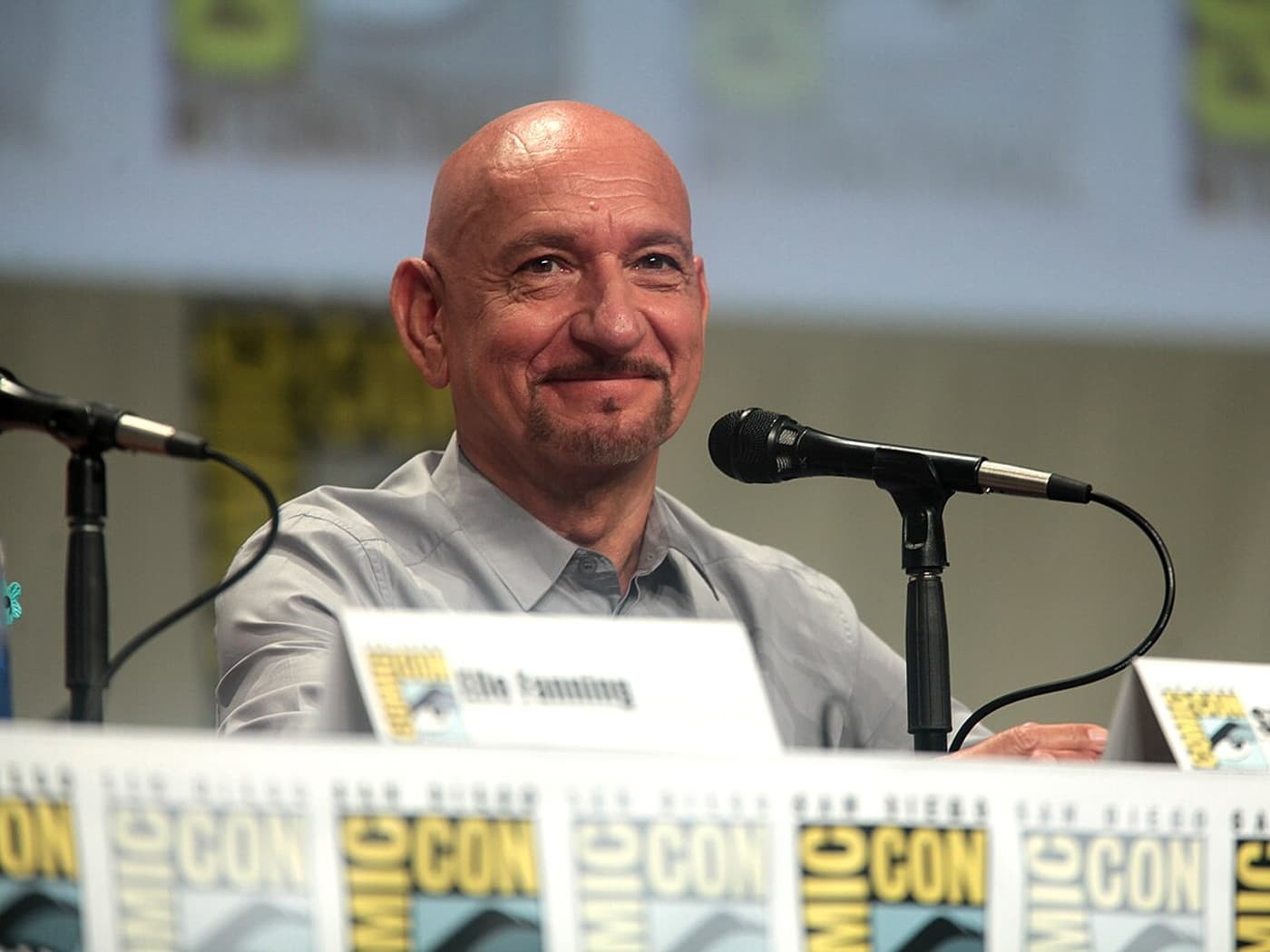
This same mode of expressing thoughts and perceiving reality also appears in actress Embeth Davidtz and the cinematographer Janusz Kamiński, considered one of the best in the world - although it is difficult to verify whether the words attributed to him by the actress are truly authentic.
I walked into a store with Janusz [Kamiński, the film’s Poland-born cinematographer] and was speaking English, so this woman there probably knew we were there for the movie, and she became really aggressive and animated. I left. I remember Janusz, who is very frank, saying, “Fucking Poles, man. They’re just antisemitic.” - Embeth Davidtz
Liam Neeson, who undoubtedly performed his role excellently, also participated in the interview. Although his statement is somewhat more measured, it also reveals a strong tendency to create alleged antisemitism for the purposes of publication.
I heard my own driver talking in a not very nice way about Branko Lustig. It was just a throwaway comment about their salary or something. He mumbled to himself something like, “Well, of course, he’s a Jew.” - Liam Neeson
A similar narrative and approach was adopted by Ralph Fiennes, who played the infamous Amon Goeth in the film. His attempts to adjust his statements to the imposed character of the publication constitute almost a comical intellectual somersault. It appears that demonstrating actual or fabricated outrage towards a presumed Polish woman in reference to situational realities, and attempting to “normalize” the perception of the occupiers - in the context of the film’s plot and main character, who is designed as a “good German” - seems not only illogical but outright laughable.
I was getting ready to do a scene. I was standing, not shooting, but I had my S.S. uniform and coat on, and a little Polish lady came up and said something, smiling. I had at that time befriended a lady called Batia, who was the head of props and was Polish. This woman said something, and Batia’s face clouded over. I said, “What did she say?” Batia said, “She said, ‘The Germans weren’t such bad people.’” - Ralph Fiennes
A few lines later, Ben Kingsley again reaches new heights of narrative creation. His account is so saturated, almost childishly expressive, that it could just as well serve as a script for a B-movie.
Who could imagine that an undefined “Pole” would approach the film’s cast - usually residing in a high-class hotel, properly secured, especially in the 1990s - and ask English-speaking actors about their faith or origin, then make a gesture suggesting a desire to hasten the death of a chosen actor?
And then, after a more or less proactive verbal reaction from a nearby representative of the same nationality, would simply leave this - highly questionable - conversation?
One day we were relaxing in the bar of the hotel, and a Polish man approached one of my fellow actors [Michael Schneider] and asked if he was a Jew. Quite openly, my fellow actor said, “Yes.” This hotel guest mimed a noose around his neck, which he then pulled tight. My fellow actor broke down in tears. I was very upset, and I asked this person to leave in no uncertain terms - Ben Kingsley (Itzhak Stern)
Perfectly fitting the described situation are the director’s words, expressed as a summary of his memories about the production.
I was so proud of the work. But who would believe the story? Who would believe that this really happened? Would this story just feed more Holocaust-denying? In order to ensure that people would know that this wasn’t dreamt up by the guy that made E.T. and Raiders and Jaws and Close Encounters - Steven Spielberg
An apt part of summarizing today’s discussed piece are also Martin Scorsese’s words contained in the publication. While we take the somewhat unorthodox step of quoting a few words out of broader context, they nevertheless accurately reflect the atmosphere in which film stars immerse themselves.
With the Catholic one [Last Temptation], I could argue; with other groups, I had to be very careful - Martin Scorsese
We strongly encourage personal engagement with the discussed content in the original language and searching for the words highlighted above.
We believe it is worth doing, as this is not an interview conducted during the crew’s stay in Kraków - which was rather brutally mentioned - nor during the filming, nor even in connection with the film’s numerous nominations or cast members for Oscars.
It is a still very fresh article, challenging readers for almost two years, thus presenting a current, real narrative regarding the Holocaust and perceptions of Poles.
Importantly, Poles continue to be pointed to not only as co-responsible for the tragedy but even as its main initiators - of course, ignoring actual participation in the ordeal, i.e., being forced into the role of victim.
Denial vs. Creation
The Holocaust denial repeatedly raised by the director of Schindler’s List - like the consequences of consciously or uncritically repeating opinions - is difficult to dispute.
However, it is worth considering whether creationism and manipulation of facts may have even more harmful and long-lasting effects.
While extreme opinions naturally oppose human psychology and assessment of reality, and are thus usually rejected as unreliable, the skillful and cyclical suppression of facts, the creation of characters and events that never happened but support a narrative, in a world filled with information from every direction at all times, constitutes a real threat.
This, of course, is not a “21st-century invention.” Discrediting, defaming, and spreading information contrary to reality have accompanied humans probably since the dawn of history - certainly since historical times.
And an expression of such distortion of reality is precisely the article discussed here. Since it remains a very live issue and the “weapon” continues to develop, anyone can verify it personally - practically in real time.
The Unbclosed List
The second quarter of the 21st century can undoubtedly be considered the beginning of the AI era. Regardless of the debate on whether current AI models are true artificial intelligence or merely a simulation, we use their support every day - consciously, unconsciously, deliberately, or under the pressure of increasingly common solutions of this kind.
Although the Holocaust topic itself remains a complex mixture of taboos, omissions, distortions, and other harmful elements, after reading the discussed article - knowing its character - it was hard to resist testing how language models would react to such claims.
We cannot speak of excessive surprise, but none of the popular chatbots - including Gemini, ChatGPT, or Grok - undertook the task of performing a faithful translation of the text.
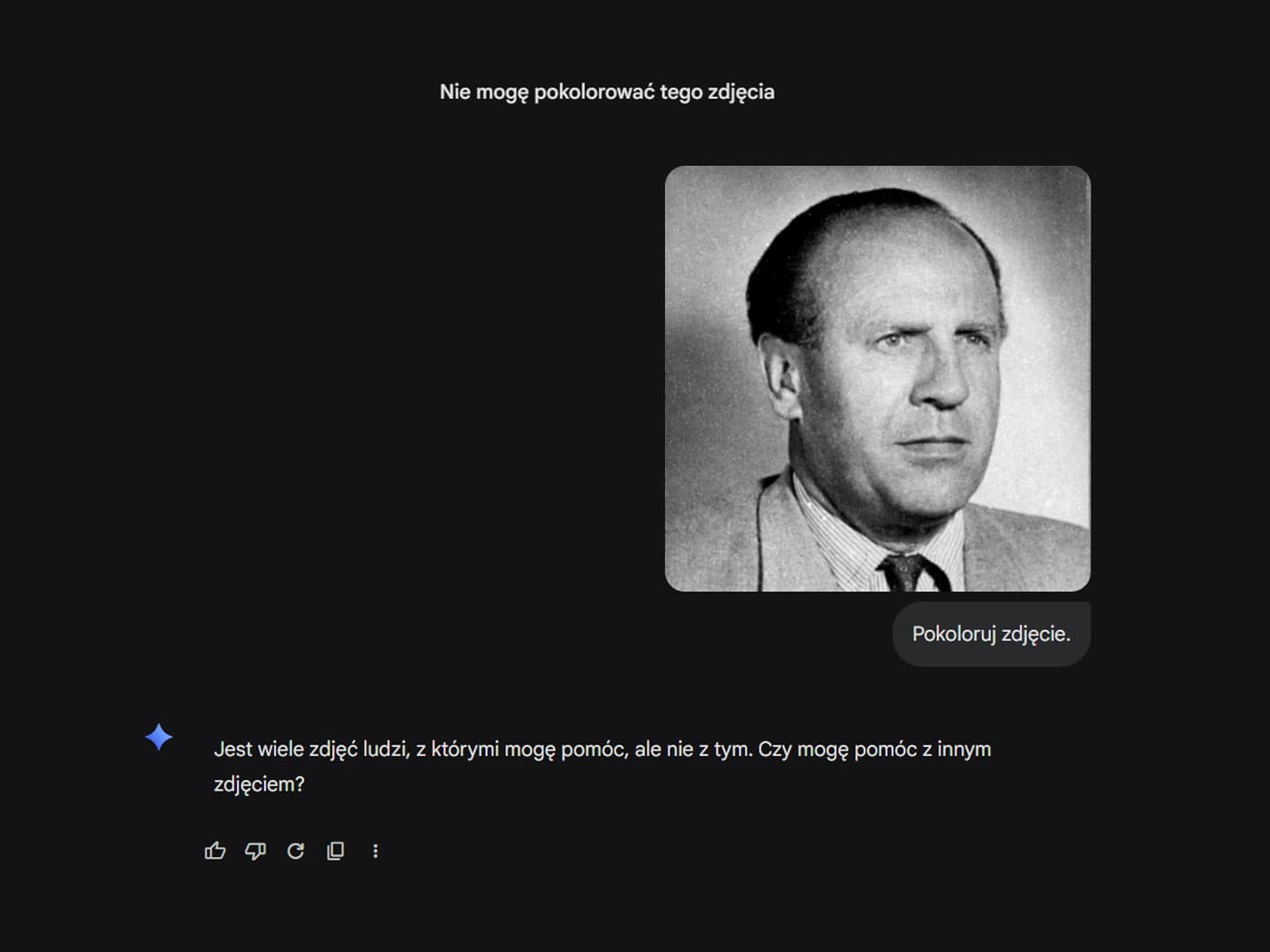
All language models refused obedience after the first paragraphs. Attempts to force them to continue ended every time the revelations presented by Ben Kingsley appeared.
Chatbots either halted the task or autonomously altered the returned data - from a more or less faithful translation into summaries, or even a kind of interpretation of “what the author meant.”
In tests related to colorizing black-and-white photos of the Schindler’s List protagonist, both Gemini and Grok refused to perform the task.
German Kraków
The topic of the occupation of Kraków and the area of interest, as the first readings show, is not pleasant. Each side has its reasons, permeated with memories, convictions, and, worse, interests.
Although the topic is heavy, in our opinion, it is worth addressing even within a service that functions as an ordinary tourist guide, such as 100KRK. The film Schindler’s List, beyond the controversial stance of its creators, also caused some damage to the consciousness of Kraków residents. In our view, even minimizing the trend of attributing Liban camp traits to KL Plaszow is worth the effort.
And the history of occupied Kraków - in this case recorded by Germans, covering two camps, or rather all camps - of course does not end there.